Sunday, November 11, 2012

Nica Spanish

Welcome to your crash course lesson in the fine art of El Nicañol. Nicañol is what you get when you take the traditional language español, throw it in a blender, forget to put the top on, then pick up the jumbled mess and try to put it back together again. That is what Nicaragua has done to their traditional language, and they're damn proud of it. Sure, every country has their own slang and ways of saying things, but Nicaragua takes it to a whole other level. I wish when I landed in Managua in July, the flight attendant would have gotten on the intercom and said, "Welcome to Nicaragua, please take any prior knowledge you may have had in Spanish and kindly throw it in the trash can, cause we don't talk like that. Thank you." It will make no sense and be confusing, but after awhile here you realize that's how most things are, so why not the language too? Here are some examples of what is so different about the way they talk here.
Epic purple sunset the other day.

"¿Muy bíen, y vos?"

This was probably the first thing you'd notice if you already knew some Spanish and came here. The word "you" is "tú" in Spanish. Nobody here says that. Here, we get to use vos instead of tú, but still use  usted when we want to be more formal. That does not mean, however, that Nicas use vosotros when referring something plural like they do in Spain, rather they still use ustedes to say "you guys". Simple enough, say vos instead of tú. I read somewhere actually that for men, it's better to learn to say vos quickly because saying tú is a sign of femininity. Weird, huh?

"¡Vos sos loco!"

Now that we've got vos down, if anyone learned to say "eres" to say "you are...", for example, don't say that either. Here, it's all about the sos. Like "vos sos loco", you are crazy, would be "tú eres loco" in any other Spanish speaking country. I was talking to who I thought was a Nica when she asked me "¿Y tú, dedonde eres?" where are you from? I immediately responded with, "No. ¿¡Dedonde sos vos!?" Where are YOU from? Turns out she was Tica, a Costa Rican. That really threw me off cause Ticos hate Nicas, and vice versa, so meeting one in Managua was strange. If you hear someone here not using vos or sos, chances are they are not Nicas.

S's are optional

This and the next one might be my favorite. Saying your S's are really your call. Plurality? What's that? For example, if I wanted to say "we have three cars", I would typically say "nosotros tenemos tres carros". Here, the s at the end is optional and would sound more like "nosotro tenemo tre carro". The less you have to say things the better, right? If the s is followed by a consonant, however, the 's' sound changes. You swallow it a bit more and it makes more of an 'h' sound. Like the phrase "¿Cómo estas?" to say "how are you" sounds more like "¿cómo ehta?" Or the word "whisky", as my host brother, Gersan would say often (lo siento, hermano) is pronounced "whihhhhhky" I asked someone here why they don't pronounce their S's and he told me cause that sounds too lispy like a stereotypical gay man would. "I don't want to sound like a Tico!", he told me.

Stem changers

For those who have taken some Spanish, we've all come to know the art of stem changing verbs. Like many of the "er" and "ir" verbs change how pronounce them depending on who you are addressing. Like tener changes to tienes, tiene, tienen when you refer to whomever. In Nicaragua, it's the same, except for the you "tú" (sorry "vos") form. Take everything you learned, and leave it in the States. Here, words like tienes, puedes, encuentras, vienes, are pronounced tenés, podés, encontrás, venís. It's weird to hear at first cause I was confused as to whom they were referring to. But it actually is easier to pronounce on the fly if you're not fluent than trying to remember what the stem change sounds like. Just pronounce it like you would in first year Spanish before knowing of the existence of "stem changers" and throw an accent over the last vowel and you're all set!

There is a billboard here advertising their national rum Flor de Caña with the quote "Lo que tenés aquí, no lo encontrás por el otro lado." What you have here, you won't find on the other side, is what it literally translates to, but I think it's more like "What you have here, you won't find anywhere else." Man is that the truth.
Huge iguana getting some sun.

Commands

Again for the Spanish takers (and on a side note, if you seriously were that kid in high school that took French or something like that instead of Spanish, what's wrong with you? Have you looked at the demographical statistics of the US over the past, oh I don't know, century? Definitely not seeing a rise in French or German speakers, and there are more English speakers in China than in the US, so that's not gonna be a problem. Come on!) anyways, the irregular commands are different. Remember the irregulars ven, di, sal, haz, ten, ve, pon, se? Never heard them in Nicaragua. Instead, it's venís for "come here", decíme "tell me", salís "leave!", hacélo, do it, etc. Another thing thats strange is the way they pronounce all of their commands. For example to say "stand up", you would normally say levántate, accenting over that first 'a'. Here, it's levantÁte. SentÁte instead of siéntate for "sit down."

Slang/Cussing

Learning how to cuss in Spanish has been one of the most fun and rewarding parts of integrating with the culture here (sorry, mom). When you can finally put a phrase together in another language to make fun of someone or call someone out in a manner that everyone gets and laughs, it's amazing. To say Nicas are vulgar is a drastic understatement. EVERYONE cusses. And I mean everyone. Old, young, mom at her kids, kids at their parents, at your dog, or complete strangers, they all do it. I would say a positive would be that it takes a lot of meaning out of the words if everyone uses it, so cussing really isn't as awful here. But it's still hilarious.

Gersan and I regularly refer to each other as maricón or cochón, which is like gay. Or when someone keeps yelling at you when you are busy with something and you get to say, "¿¡Qué la verga!?" which is the equivalent of "What the f*ck!?" You would also say that if someone cuts you off on the road, if you want to fight them, or if you about to slaughter noobs in Empire Earth and the internet suddenly shuts off. The best part about cussing here is that people just make things up to say and it's suddenly an official part of the language. For example, Gersan and his friends regularly call each other hijueputa which is like motherf-er. But if someone or something REALLY is bothering you, you can start making up things to put in between the words hijo and puta and it suddenly become stronger. Flat tire while already late for work? "¡Hijo de la setenta mil padres de la gran puta!" It literally means "son of the 70 thousand parents of the greatest b*tch" but it's more like "MOTHERF***ER!!!" Put whatever you want. It could be "hijo-of-the-fifty-suns-that-rotate-around-the-galactic-center-that-cause-solar-winds-every-40-or-50-years-and-disrupt-my-radio-when-I-take-showers-and-make-me-have-to-check-twitter-for-the-score-of-the-game-of-the-gran puta" and people will look at you like "whoa, he's pissed." So long as it begins with hijo and ends with gran puta, it's good to go.

The slang, or jerga as they say, takes a lot of time to get used to. I'll leave you with a list of what I've heard and try to throw into my vocabulary to sound proficient in Nicañol, Nica+español.

Qué paso?- (NOT qué pasa)- means 'what's up'

maje- dude, guy, girl

ideay?- what the hell? what happened? what are you doing? (say it fast enough and all you literally need to say are the letters 'e' and 'i')

tuani- cool

deacachimba- really awesome

'tonce?'- what's up, so, and

bicha- beer

guaro- rum/alcohol

chavalo(a)- boy or girl

chiwin- kid

dale pues- ok, alright, good bye, later, that's fine, you could literally say it for anything

chucha- thing

encachimbado(a)- really pissed off

bacanal- party

tocado/picado- tipsy

borracho- drunk

mamado- wasted

hasta tan bicho- (might be spelled wrong, that's how it sounds though), really really drunk

bolo- drunk

ruta- bus

ahuevado- sad

bago- wondering around, crazy, punk

rotunda- round-about

fritanga- food stand

no jodas- don't screw with me/ it's fine/ relax

There you have it. Say a bunch of those things to someone and you'll be treated like a local in no time!


Friday, November 2, 2012

The Election From Abroad

FSLN political ad. These are everywhere.

I'll sit in my room and read articles and check Facebook to see what's going on in the States and sometimes I'll have the tv on CNN watching news when after coming home from work my host dad, Manuel, will come in and ask me, "¿Cómo va la jugada?" How's the game going? Or the "play" rather. The "play", referring to the election in the United States, really looks like one when you are outside the country looking in.

Frankly, this couldn't be a better time to not be in the country, when the tv's are filled with negative ads that bend truths, and everyone becomes hyper-political all of the sudden. The second part hasn't entirely been avoided cause people pour their souls out of Facebook about how Obama is a commie or how much Romney hates poor people, or the one's who talk about how much they don't care about politics, so much so that they'll tell everyone that they don't care. For me, as an American observing the election from outside the country, it's been really liberating. I watched most of both conventions without distraction, the debates online, got to read articles I want to about issues, and then the best part is I get to explain to the Nicas just what exactly is going on.

What I've really taken from watching the election from the outside is that people in America FREAK OUT over the littlest things. You think Obama is a socialist? Cause of what, wanting to tax the rich more? Here in Nicaragua, his political ideologies are equivalent to that of Ronald Reagan. Arch, right-wing conservative. Although, many will tell me that we Americans are slowly making progress with Obama. Here, things like healthcare and education are a constitutional right to the people, like our free speech and right to bear arms. Funny concept, huh? In fact, it is required that 6% of the federal budget goes to the public universities including mine, La UNAN. The cost of tuition? $15..... per semester. And getting into the public universities is still a rigorous process to get accepted, much like ours, with placement exams and specific criteria to meet. They mean it when they say "public university". The campus is decorated with political murals and many of them you'll see the number "6%" written on them. Now that's socialism, and they're pretty proud of that wacky system, although they call it "El sandinismo" like "Sandino-ism" after their icon Augusto Sandino.

Nicaragua's political culture is palpable. You see and feel it everywhere. Literally every street light is painted red and black, the colors of the Sandinista revolution. Some is graffiti left over from the 80's, some is new. Red and black flags painted on street corners, walls, and cars. I remember one time, we were hiking up this mountain in what I thought was the middle of nowhere and lo and behold, there's a large boulder painted red and black. The paintings were done to not just to inspire people to join the cause, but also to signal to others which parts of a city had been successfully liberated by the rebels. It's like the "V" in the movie V for Vendetta, but real. Billboards of a cheery President Daniel Ortega smile down at you at every round about. I remember when my host family picked me up for the first time from our program orientation. We talked small-talk for about five minutes, then all of the sudden,

"Christian, we were 18 when the revolution happened. Hey, did you know Samoza (the military dictatorship) was killing people? He killed kids, Christian!"

Stunned, all I could really say was "Oh, wow..." On a weekly basis, we'll be at the dinner table and they'll tell me their story.

My host mom, Mercedes, participated in the clandestine movement in Managua during the revolution, when Somoza's National Guard soldiers were going house to house searching for and killing people harboring Sandinista rebels. Her house was one of these safe houses, and her job was to create make-shift first aid and supply kits for the rebels as they participated in guerrilla warfare in the city. She also said she would go around and collect tires, pile them up then light them on fire. The smoke was used to communicate with the other groups hiding throughout the city. They also created road blocks and damaged the streets so that tanks could not pass through.

 Manuel, my host dad, was a captain in the Sandinista army. When the Contra War started in '83, he was sent to the border of Honduras, where they fought the Contras and waited for what he said they thought was "an inevitable US invasion" at the time. Their stories really put things into perspective for me. I couldn't imagine hiding out in some house in Denver from my own military as they went house to house killing people. I then can't imagine standing in the mall in Washington DC, celebrating overthrowing the American government. It must have been some time.

I also got to vote  in the US election while I was here. The process wasn't all too hard thanks to the internet and our program office having a scanner. I filled out a few forms online, printed, signed, scanned, then emailed the ballot and I was good to go. I thought I was gonna have to go to the embassy on election day and figure it out from there, but thanks to existing in the 21st century, the process went smoothly.

We have it pretty good in the States. It was funny for me to see Romney talk about one in six Americans being in poverty while I am living in the second most impoverished country in the Western Hemisphere.

 Poverty, huh? You don't see houses in the States made out of scraps of metal while people burn trash to heat their stove for cooking. Neighborhoods don't get flooded with everyones discarded trash every time it rains. Parents don't have to send their kids to school to get just one free meal that day. Don't get me wrong, we have people who are struggling to get by in the US, but it could be a lot, lot worse. America is fine. And we'll be alright regardless of whoever is president. Watching our election from such a politically charged country has sincerely been a treat.

Sunday, October 21, 2012

Weekend Adventure in León

One of many churches in León, Nicaragua

After what seemed like an extremely short week of class, mainly due to class cancelations and other projects by my Nica classmates, it was time for another adventure. This time, we went to the city of León. León is about two hours by bus north of Managua and actually used to be the original capital city of Nicaragua. After constant civil war to run the country between León and their arch-rival Granada in the 19th century, Managua was set as the capital as an attempt to resolve the dispute. Today, the rivalry still exists between the two cities, as my host-mother, Mercedes, constantly refers to Granadinos as "las fresas" which literally means strawberry, but the term is used for people who are rich and stuck up. Here's some of the highlights of the trip to León:

A/C on the microbus

Nicaragua is hot. The month of October is supposedly in the heart of the "winter" here, which just means it rains more. There really has been no difference in climate since I got here in July. It's 90 and humid everyday (not quite Florida humid, but it's up there) and ever third day or so it will rain, sometimes for five minutes, others for hours. Nevertheless, it's hot as hell, and having air conditioning is a luxury. My house has no a/c, but you'd be amazed at what shade and a fan can do. None of my classes have a/c, so I will frequent our study abroad office which sometimes gets too cold for Morena, our lovely Nica assistant program director. I will often see her wearing a scarf and a long sleeve shirt at her desk. The buses here, however, NEVER have air conditioning. So when Zoe and I boarded the minibus to León to feel the icy chill of air conditioning blasting from the overhead vents, we knew this was something to cherish. It was raining for most of the trip and not all that necessary for maximum air conditioning, but I left the vent on me, feeling cold on public transportation for the first time.

Holy León

León is a very colonial looking city. It looks much like Granada, with brightly colored painted buildings with old terra-cotta roofing, narrow streets, plazas and murals. What's different however,  is as you go about the city, you'll notice the un-Godly (pun intended) amount of churches and cathedrals they have. Every direction you look, at the end of the street is another well-kept, or not, church of "insert saint" here. The Basilica de la Asunción is the largest cathedral in Central America, and we got to check it out while they were going a Mass. I definitely was getting some looks as I walked around to watch and take pictures. A chele "white guy" in shorts and flip-flops, wearing a Colorado Rockies t-shirt in this beautiful cathedral, taking pictures during mass. You kinda get used to getting stared at here, so it's hard to tell if you are doing something wrong, or they are looking at you cause you're foreign. The churches were all really cool and made it easy to navigate the city cause we could orient ourselves with whichever church we were by.

Trusting locals: a double edged sword

On Saturday, Zoe, Sheena, and I were supposed to climb this volcano nearby at 8am but ended up changing to the 2pm climb cause Sheena couldn't make it from her town she was living in time, so we had some time to kill. The guy who was going to be our guide that afternoon, Anly, suggested that Zoe and I rent bikes and ride to the beach to have something to do before the hike. The beach town, Poneloya, was kind of far from León, but Anly insisted that it was downhill on the way there and that we can take the bus back. We decided to to it and rented bikes for the day for $5. And after now having two bike rental experiences, it is important to keep in mind that you get what you pay for. Initially, the ride was great. It was a slight downhill on a nice paved road as he had said and we rode right through the barrios of the city and into the countryside, passing farmers with machetes and racing a Nica kid also on a bike, but about halfway through the ride, the road started to get a little more hilly. We'd petal up a small hill, only to find at the bottom another hill to climb, only bigger, then another, and another, and another, and another. It started to get really, really hot. I also remembered that I had completely forgot to buy sunscreen since I was so excited for an awesome bike ride to the beach. I am currently writing this blog with maroon arms and face.

 After another long and exhausting hill climb, we finally saw the ocean in the distance, but still had some way to go. Seeing that there were no more hills to climb and being at the top of a huge one, I petaled as hard as I could to make up for lost time. No sooner was I hauling ass down this hill than I rode over a small pile of rocks (pebbles rather) on the side of the road, instantly tearing through my back tire. You get what you pay for. I had to slammed on the screeching brakes as I was quickly loosing traction, got off, and walked on my bike down this hill in the middle of nowhere. Zoe at this point was way ahead of me to see what happened, so I was on my own. The heat was absurd. There's a saying about León here that's like "If hell froze over, Satan would move to León" or something like that. I was drenched head to toe in sweat and my skin on my arms was already pink. This wasn't my first rodeo, however, as a very similar bike-tire-popping-in-the-middle-of-nowhere incident happened while we were in Granada. After about 15 minutes of walking, a guy on a bike with this girlfriend sitting sideways on the frame (a very common sight here actually) passed by and I asked him where I could get my bike fixed. I was in luck. About ten minutes down the road was this guy's bike shop, where for a dollar he patched up my tire and I was back on the road. Zoe had stopped a bit down the road and I caught up and we continued to Poneloya. The beach was only OK. We took the bus back. That bike ride was long. It turns out Poneloya is 20km (12.4 miles) from town. Next time a local suggests something to do, ask a few others to see if it's legit. Or just wear a hat and some sunscreen.

Volcano surfing, anyone?

At the bottom of Volcán Cerro Negro. 
Zoe and I arrived back at the hostel with just enough time to reapply some deodorant and head out to climb Volcán Cerro Negro. Our guide, Anly, who had suggested what he claimed was a very tranquilo "relaxing" bike ride laughed when I told him that it was quite the opposite. We met up with Sheena and got driven out to the volcano. Cerro Negro means black hill, and that's exactly what it was. We drove down a volcanic black road and arrived at the base. I was equipped with a backpack that had everyones padding and suits, and a "sand board", which was a block of wood in the shape of a snowboard with nylon straps for bindings. We headed up the trail for the 45 minute ascent to the top. The terrain was surreal. We were on this black landmass with no plant or animal life surrounded by a sea of green hills and trees. It felt like another world. We walked between these large black boulders and the trail was marked by painted arrows as if to say "this general area is the trail". It also felt like I was in the Lord of the Rings, scaling the rugged Mount Doom of Mordor to throw the One Ring into the volcano to rid the world of darkness. Keep an eye out for Smeagle, he's always ssssneaking. Anly agreed on with me. The complete contrast of the black volcano in green, tropical Nicaragua would get anyone's inner Frodo going (maybe Sam, or Merry, or Pippen. Frodo's kind of a sissy).

As we were nearing the top, it started to smell like exploded firecrackers, that sulfury, gunpowder smell. At the top of the ridge, we could look down into the volcano, which had no lava unfortunately, but had red sand and was steaming a lot. We hiked around to the other side of the ridge where only the volcanic sand was. The view was great. It had started to rain, so we put on out kneepads, elbow pads, gloves and then our protective "suit" which was like a jean ones'ey and it was time to surf down the steep (like really steep) 400m hillside. Anly told me to lean back as much as I could and how to stop. I told him I knew how to snowboard, but this turned out to be way different. Volcanic sand is like thick, heavy powder. To keep from burying my board in the sand, I was leaning to far back on the tail that I was basically sitting on my right foot. Since the bindings were barely holding on to only my toes, carving was out of the question. So it was back to snowboarding at age 8 again: get some speed and then fall on my toe edge. I got some good speed a few times, but trying to stop meant falling completely on my stomach, getting a face full of black volcanic sand. Still, surfing down an active volcano? How often do you get to say that? We all made it down in one piece and headed back into town.

"I think we're in a gay bar..."

After a 12 mile bike ride to the beach, scaling a volcano and then surfing down it all in one day, it was time for some drinks. Zoe and I decided to see what was going on in the city, so we ate at a mexican restaurant (which is NOT like Nicaraguan food, I hadn't had a spicy burrito in months!), and found this bar afterwards right by the hostel. The place was called Guadalajara, or something like that, and there were a bunch of people in it, so we decided to grab a table. We ordered a media "half liter bottle" of Flor de Caña rum and talked and what not. The bar looked cool, there were cool lights everywhere and a mini courtyard in the middle, and they had your typical "latest electro-hits" blasting from a PA speaker. I was watching a group of friends across the bar at a table dancing to the music and taking shots. One of the guys was really getting into the music and dancing up a storm, but I thought nothing of it, a lot of guys here dance like that. I went over to the bathroom and the guy outside the men's room  looked at me and told me there was a line and gave me a smirk. Still thought nothing of it. I was finishing up peeing when the door just opened right up. I quickly zipped the fly and the guy who opened the door laughed and he, his "friend" and another guy all walked in as I was still putting my belt on and walking out the door. "Adiosssssss" one said to me in a rather flirtatious manner, and they didn't even bother to close the door before peeing, nor did they care that they were all in the one person bathroom together...

I stood outside the bathroom with my new state of awareness. We were in a gay bar. How had I not noticed? I looked around. It was so obvious. It was ALL dudes minus Zoe and two other girls who were friends with the guy who was a little too good at dancing. The lights were a little too pretty, and multi colored. I walked past two guys grinding the night away, and was getting looks from everyone. I sat down at the table laughing. "Zoe....I think we're in a gay bar." She looks around. All dudes. The v-necks were just a little deeper, the jeans a little tighter than you'd normally see. I pointed out the two dudes that were dancing but now were making out. We both lost it. Don't get me wrong, I have nothing wrong with gay people, I just never go out thinking about gay bars whatsoever or that I'd randomly walk into one, especially in Nicaragua of all places. We finished our drinks and left, this time I was getting the attention from the guys, not Zoe or other girls here. So that's what it's like, huh? Bike riding adventures, the beach, volcano surfing, then a gay bar to top it all off. Easily going into the list of most interesting days ever.

Sunday, October 7, 2012

Three months in

Pineapple banana smoothie in a bag. Delicious.

Wait, it's October!? I cannot believe that I have already been in Managua for three months. The days have been blending together. I am more than halfway done with my semester and realize that I have not yet written about how my classes are going. Well, I'll tell you. I am enrolled in four classes here at UNAN-Managua. One class is taught by Hector, our program director, and only the five of us take that class. It is titled "Poverty, Revolution, and Neoliberalism in Nicaragua" and has probably been the most interesting class here. The other three classes are taken with Nica students and professors. I have the same professor for two of them (Latin American Social Movements, and 20th Century Nicaraguan History), and he is very cool. He'll frequently ask me for my perspective on things and to clarify historical facts about the US, which I like but it means that I have to always be paying attention and make sure I've got my facts down (by the way, when they tell you that you should freshen up on the policies and history of the US when traveling somewhere, make sure you do that. Especially in Latin America, where we've played a huge role in their history. Because you will be quizzed and debated with, and you don't want people to think Americans are ignorant. Don't ruin it for all of us!).

 My other class is a seminar on Central American history, and I despise it. There are about seven of us and it is mainly discussion based. The professor speaks very quietly and mumbles a lot, which makes him very difficult to understand. He is also constantly tearing down the US, which isn't what really bothers me, I don't mind hearing it from a different perspective, but sometimes he just sounds straight up ignorant. Unlike the other professor who will ask me for my opinion from a more neutral perspective, this guy will make me defend the actions of the United States that were clearly wrong. It gets really old. He told me that when I get back to the States to ask my local representative about when the US will stop messing in Latin American affairs. "You got it sir..." He also shows no sympathy to the fact that I am not fluent in Spanish, so if there's something from the reading that I may have not seen, he thinks it's because I don't read and don't do any of the work and will constantly call me out. The students are very nice however and will always help me out if I missed something during class.

What has been fascinating about being here for three months is noticing the huge difference in traveling somewhere and actually living there. When you travel to a different country, you stay in your sort of "bubble" so to speak. Your perspective stays the same. You really never adjust to the local society, customs, even language. You form a sort of barrier between you and the local culture. Everything is foreign and exotic. You are always on the outside looking in. But after a few months of living in a different country, those barriers start to come down. Things become familiar and not all that strange. You know how to get around the city and travel to other ones. It starts to feel more like home. I don't want to say that there aren't things that still surprise me and seem odd or funny (like a family of four on a dirt bike always gives me a good chuckle for example), but there are many things that I have adjusted to since July. Although I am probably missing a ton of things that would have been odd to me at first, here's some that I can name:


  • Cold showers
  • No A/C, the heat in general
  • Stray dogs
  • Riding the bus (always a good time)
  • Streets with no names ("It's two blocks to the lake (north), one block up!" (up is east))
  • Car alarms at all times of day
  • Rebecca, the parrot, that lives across the street. "¡Buenas!" "¡Hola amor!" For the first few weeks I thought it was some kid yelling at people as they passed by.
  • Riding in pick up trucks
  • Loud music
  • People with machetes
  • Ants and lizards in the house
  • Every street light painted red and black (FSLN colors)
  • Revolution and political graffiti. Seeing Sandino's picture everywhere
  • Drinking out of bags
  • Bargaining with cab drivers
What I have not gotten used to here are the clouds. I know that sounds weird, but it's true. These things are MASSIVE and they make the coolest shapes and not to mention ridiculous sunsets, which occur every day if it's not raining. This was one I caught the other day...


I've also found out that all you really need in the world is an internet connection. Anyways, there's still a bunch of places I still want to see and things I want to do (like sand boarding down Volcan Cerro Negro!), so I hope the next few months are equally as cool as the first three.


Tuesday, September 25, 2012

Rio San Juan

El Castillo with the Spanish fort above.
Last week, the group and I spent four days in the mythical Rio San Juan. Rio San Juan is the river that forms part of the border between Nicaragua and Costa Rica and connects the Caribbean Sea to the Lago de Nicaragua, and it is massive. On Thursday, we piled into a taxi and went to the airport, where we then rode in a tiny, 10 or so passenger, plane to the town of San Carlos. After the 45 minute plane ride, we touched down on the small dirt runway in San Carlos, and then had to go to the boat station to take the 3 hour boat ride down to the river town of El Castillo, where we would be staying. The boat ride was incredibly long, but never boring as we got to take a look at some of the more incredible scenery this country has to offer. We'd pass by houses on the river that were elevated off the ground to get away from the seemingly unavoidable mud. There were people fishing with both nets and poles in the river and families including grandma and the baby riding in their canoe, waving as we passed. The boats here operated more like the city bus, dropping people off and picking them up in what was seemingly the middle of nowhere. It's like, "Hey this is my stop." "Where? The taller tree next to the stork and that coconut tree?" "Ya. That's the one." That's how it works here. 

We finally arrived in El Castillo and went to our hotel which had an amazing view of the whole town (which was tiny, like it had one street tiny) and the river. Castillo means castle in English if you didn't know. The town is called that after the 17th century Spanish fort built up on the hill overlooking the river. The fort was built to protect the cities on the lake from the actual Pirates of the Caribbean during their hay-day after the city of Granada was sacked something like five times over a span of three years. For me it was really fascinating looking out from the walls of the fort thinking that Henry Morgan (yes the rum guy) rowed up this river with his mates in canoes to go blunder some towns. On Friday, we went to check out a cacao farm. As usual, the adventure to get there was equally as cool as the destination. After hiking through the cows and the mud, we ended up on the shore of the river. On the other side of the river was a house that had a canoe type boat. Our guide whistled and out of the house and into the boat came a mom and her son, who paddled out to our side to ferry us across the river. There were eight of us in the group, and they claimed that we could all fit without sinking the boat and turning us into crocodile and shark (yes the only fresh water sharks in the world live here) food, but this was debatable. We all piled into the canoe anyways which put us about three inches above water level, and remained as still as we could as to not rock in either direction during the crossing. Somehow we made it to the other side, where the dad of the family offered us some coconuts, prodded them out of their tree, and hacked them apart with his machete. Delicious.
Our lovely "ferry".

The river crossing process had to be done two more times, one by sketchy canoe, and the other (my favorite) was a contraption that the cacao farm guy had built that was a zipline swing where you would sit on this board and fly across the river to the other side. We had arrived to the cacao farm, where we got to cut open some cacao pods and eat the seeds. The guy who worked at the farm showed us around and pointed out some of the wildlife living there like bats, iguanas, and even a sloth. After the farm, we went to a place where they use the cacao seeds to make actual chocolate. The women who worked there showed us the process of how to make it and we got to help. We then tried the best hot chocolate I have ever tasted and also made our own chocolate candy to take with us. After a long day of hiking and chocolate indulgence, we returned to El Castillo to prepare for another fun day on Saturday. On Saturday, we made the drip down the Rio San Juan to a nature reserve called Indio-Maiz. The entrance of the reserve was also a military outpost since we were in the part of the border where Costa Rica is on one side of the river and Nica on the other (and they don't like each other very much). After some passport information from the very young looking soldiers strapped with AK-47's on their backs, we were off again, shin-deep in mud in the jungle. We got to check out some gigantic trees, tiny poison frogs, and some curious monkeys passing by above us. We even saw jaguar paw prints, which our guide told us were no more than a day old! After a long, muddy hike that had changed my definition of both hot and humid, we ended up by a smaller river surrounded by massive trees and the sounds of howler monkeys, where we got to swim for a little.

We returned to El Castillo and got to relax for the rest of the day. The town is very peaceful and has no cars. The only road is more like an oversized sidewalk where everyone hangs out in their rocking chairs and windows and talks to neighbors. We were on our own for dinner, so the five of us and Morena went to a restaurant and had some Flor (Nicaraguan rum) and played a drinking game called King's Cup. I don't want to boast, but I'm pretty sure we were the very first people to ever play King's Cup in this sleepy fishing town. This of course was made much more difficult as it all was done in Spanish. We awoke the next morning at 4:30 to catch the 5am boat ride back to San Carlos and the airport. The morning boat ride on the river was amazing. We picked up many morning commuters, farmers with mud boots and machetes, and saw hundreds of birds hovering above the river going to town on some bugs. The trip was definitely very cool and very tiring. I will be returning to the Rio San Juan in the future. 

Monday, September 10, 2012

Tremors in Managua/Granada Weekend


I am teaching a semi-behaved second grade class the numbers in English on Wednesday with as much enthusiasm as possible to keep their attention when outside the class I see all of the first graders, of whom I had just taught in the previous class, standing in the courtyard laughing and screaming. The teacher, dressed in her semi-nun attire, pokes her head into the class and looks at me,

 "No lo sentias?" (You didn't feel that?) 

"Feel what?" I asked.

"Los temblores (the tremors)!  That's why my kids are outside cause they're scared."

Confused, I looked at my class and asked them, "Did you guys feel that?" They all laughed and said yes. For roughly 15 seconds, there were slow tremors that were felt all over Central America due to a 7.9 magnitude earthquake that took place in northern Costa Rica, of which no one was killed to my knowledge. I asked the teacher if she wanted my students to stand outside as well and she said, "No, it's fine, you can keep going." I laughed, "Oook!" and continued my lesson. This was the second time that tremors have been felt in Managua since I have been here, and the second time that I have not felt them. This was probably due to my oblivious nature as I was trying to focus on teaching these kids some English. Apparently, this one was pretty strong. One girl in our group, Jennifer, said she almost fell over in the shower when it happened. The tremors were all the buzz here last Wednesday. School and some work was canceled and a tsunami warning was in affect for the Pacific coast (now lifted). This phenomenon is not at all rare here, however. Nicaragua is one of the most geologically active regions in the world, situated on the edges of the Caribbean and Cocos tectonic plates, which explains the 40 some-odd volcanoes and constant seismic activity. Managua especially gets a lot of activity because of a vast intertwining network of even smaller plates constantly moving around underneath the surface. But hey, gotta live life on the edge, right? (insert drum sound).

After a few days of listening to semi-pesimistic news anchors warning us about the end of the world as we know it, and a week of class, Bobi, Zoe, and I decided to head on down to the colonial city of Granada for the weekend. We hopped on the bus in an increasingly familiar fashion and took the hour journey south. Granada is awesome. The two places that everyone hits up when they travel here are San Juan Del Sur and Granada, and it's obvious to see why when you get there. The town is very pretty with old, colonial style buildings painted in the brightest of colors. Every building and house is painted differently. The streets and sidewalks are narrow and the central plaza features La Cathedral de Granada, a huge yellow and white cathedral that towers over the city. The guidebook I read claims that you will want to take as many pictures as you can when you walk around here, and it was spot on in that regard. I might have taken over a hundred pictures. The combination of freshly painted and up kept  buildings with older rustic ones would make any photographer go nuts. We arrived Friday night and found a hostel someone had recommended to us called Las Oasis. It costed $10 per person per night (a little on the expensive side) but did come with a pool, some hammocks to hang out in, and free coffee, so that it was well worth it. 

On Saturday, we decided to walk into the marketplace to find a place for some cheap food. Markets always have areas with tables and food that people will cook for you called comodores. Granada's marketplace was pretty nuts, but not as intimidating as those found in Managua, so we found a comedor fairly quickly and had a delicious and cheap breakfast consisting of rice, beans, pork, and  sweet plantain. We then walked down to the main street where there were places to rent bikes for the day. For $6, you can rent a bike for the entire day. We rode along the shores of the giant Lago de Nicaragua, home to the only fresh water sharks in the world (although a sighting is now rare), we ended up at this peninsula named Asesse, which is surrounded by hundreds of tiny isletas (islands). The paved road turned into dirt at the beginning of the peninsula, and this turned into a little adventure. The bike I had rented was alright to take some bumps even though it had no shocks, however Zoe had a road bike, and her back tire was already losing air. About 20 or so minutes into the ride, it had gone completely flat. Since my bike was good to go, I sped ahead to see if anyone around had a bike pump. I ended up asking a few people in their homes along the side of the road and they said there was a place close by where they'll fix it. We quickly found these guys working on some motorcycles and they said that they could patch it up the tire. After fixing Zoe's bike, we rode around the jungle some more and headed back to town. 

Later that day, I headed off on my own to find this cigar 'factory' that I had read about where you can watch people hand roll cigars and even make your own. Once I found it, however, they were open but the employees only make cigars a few days a week and today wasn't one of them. Whatever, I bought a pack of small cigars and lit one up as I continued walking around the city, taking photos, and listening to someone music from someone's PA speakers. I found this other old cathedral nearby and noticed that there were a few people standing on top of the bell tower some 80 feet up, so I decided to see if I could join. I ventured up the steep and narrow spiral staircase all the way to the top and found myself looking at yet another incredible view of Granada and the surrounding area. After a few minutes of pictures and soaking it all in, a priest in a white and red robe walked up there and said to stand aside cause he had to play the bells. Awesome! I took out my camera and filmed it (should have the video up soon). It was really neat seeing him swing these huge ropes clanging the bells over and over again. The amount of sound those things make is absurd (sorry eardrums), but it was something to see! Granada weekend=great success.

I have now been in Nicaragua for two months and am still having an experience of a lifetime. How this place seems virtually unknown as a travel destination to many Americans is a question I find myself asking with every new volcano I see looming over a new town, every empty beach we find, every colonial city I walk through, every tourist I hear speaking English in every accent except and American one, and every time I ask "Wait, for one dollar?" Yes. One dollar for: this entire meal, that beer, the bus ride to another amazing city, an infinite supply of various fruits, and so much more. Nicaragua is stupid pretty, and stupid cheap. I hate to say it, but the guidebook nailed it. "World class views, from a $3 boat/bus ride," was an incredibly accurate description of this country. Many won't even consider Nicaragua when thinking of a travel destination, but sometimes, when you're standing on top of a cathedral bell tower with an entire view of a beautiful colonial city and not one, not two, but three different volcanoes in different directions, you're kind of ok with that. 


Sunday, September 2, 2012

Trip to La Garnacha


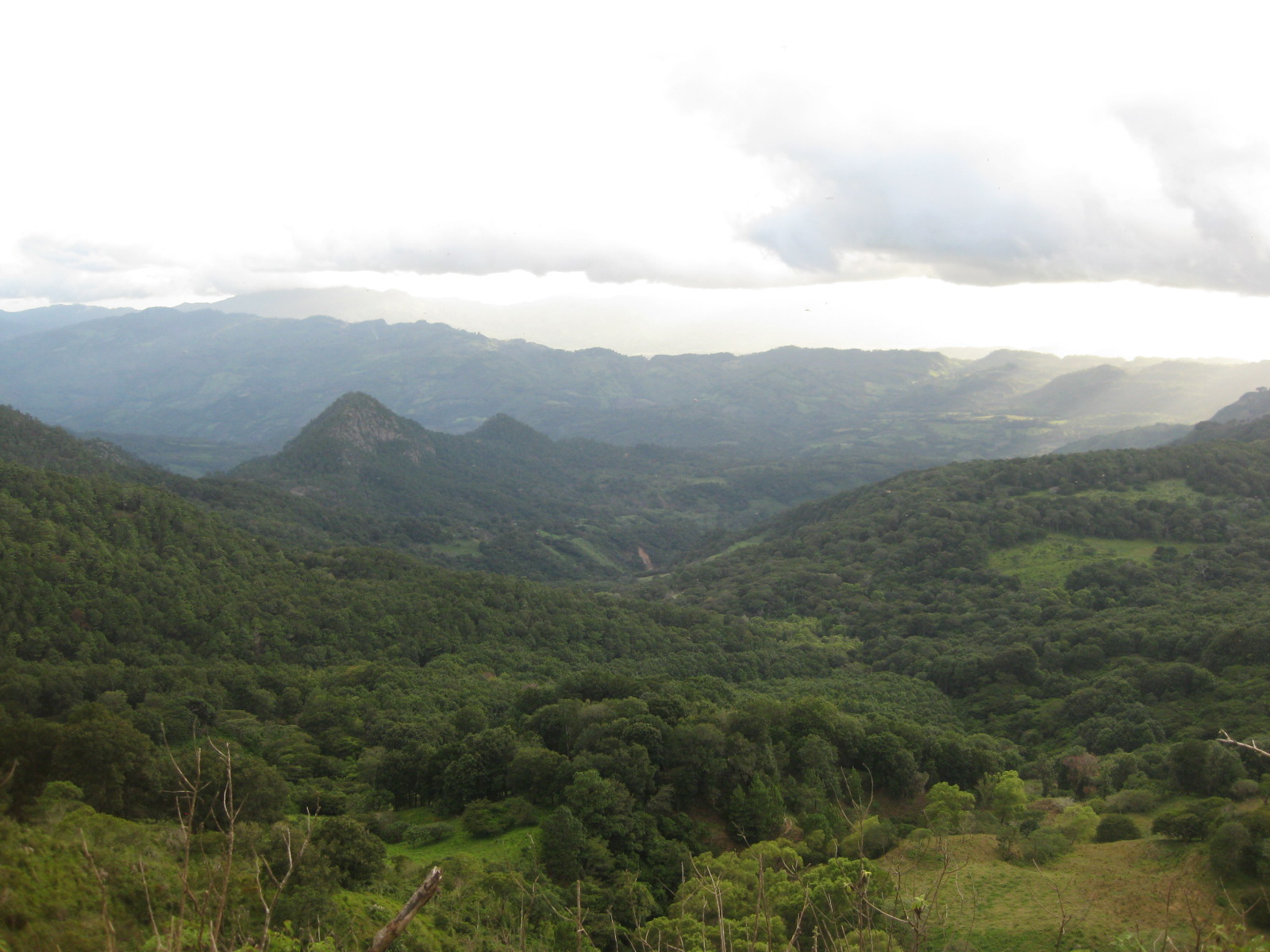
Last weekend, the group and I took a trip north to the department of Esteli (es-te-lee) to a small town in the mountains called La Garnacha. Our purpose was to view the community project that they had going on over there in the area of ecotourism. We got in the van and headed off for the 3ish hour voyage north near the Honduras border. This part of the country is completely different than in Managua (I feel like I'll be saying that a lot). First off was the topography. This region of the country is very mountainous. Esteli is situated at an altitude of about 1200 meters (3,900ft), meaning the climate was much cooler, like 70's and 80's year round. That was a great relief from the sauna that Managua can be. But what threw us all off at first was the drastic change in plant life. As we climbed higher, the tropical life we were used to seeing began to mix with tall pines and oak trees. "You won't find pine trees in Costa Rica!", our guide said proudly. Think the climate and mix of plant life in Southern California and you've got a pretty good idea.

The cabins we stayed in.
 When we got to La Garnacha, which was nothing more than a block of rural homes on a single dirt road, we stayed in the cabins that they had built to support their semi-new ecotourism industry. The town used to be a cooperative farm for the Sandinista regime during the revolution years, which means they pooled their resources to help each other out (a wild socialist idea), and now they are still doing much of the same with their tourist project. This gives outsiders access to some great hiking trails that lead to absolutely stunning lookout points, but the profits go directly into the community. Another place you can check out is an area dubbed "La Cultura y Historia de Nicaragua" which was interesting to say the least. We hiked about 30 minutes out of town through the farms and into the woods. We stopped at this house where there was this old skinny man, Roberto I think was his name, who had to be in his 70's. "Bienvenidos a la Cultura!" (welcome to the culture) he said proudly and he made us follow him into the woods where there were these stone carvings everywhere. At first, I thought that these were some sort of ancient carvings of animals and symbols, but it turns out it was all the work of Roberto. He lead us up the hill to this cliffside that had a stupid-pretty view of the northern department of Esteli. The cliffside had even more carvings he had done that featured everything from elephants and eagles, to the Bible and even the World Trade Center. There were hundreds and hundreds of sculptures carved into the face of this mountain. Roberto showed us his latest project, another eagle, and his method of carving. He created everything we saw with a metal chisel and a rock and not only that, but that he has been doing this for 40 years! For 40 years, almost everyday he walks into the hills and carves on the cliffside. Hector then told me that he was also did not know how to read or write. All he knows how to do is make these amazing stone carvings that he imagines in his head. That was really something to see. After our visit to "La Cultura" we continued to hike up this steep hill, and we got to watch the environment change around us. We began in a tropical jungle, but we then climbed into a forest of deciduous maple trees, something similar to the northeastern US. But after climbing a bit higher, we were surrounded exclusively by huge mossy pine trees. It felt like Colorado! It was definitely a little disorienting.
La Cultura

Roberto (I think) with his latest work.


The next day, we checked out some of the farms and their local cheese business. We ate some bomb goat cheese and talked about their project they had going on there. After lunch, we left La Garnacha and headed further north to this town called Somoto. There we went on another hike to a 40 or so foot tall waterfall. But we didn't just look at it, we rappelled down it (swimsuit required). After some lunch and waiting briefly for a monsoon like storm to pass by, we got back in the van and headed for Managua. What I took back from this trip was the immense diversity that this country has to offer. Nicaragua is half the size of Colorado geographically, but is jam packed with vast environmental and cultural diversity in such a small space. Almost every town is unique and can show you something that you've never seen before. It's something everyone should experience.